
Enterprise
Data Operations
for Excel and Word
Enterprise
Data Operations
for Excel and Word
Stuck between rigid systems and risky spreadsheets? The cost shows up in every close, every audit, every number that doesn't tie.
ALLOS is built for exactly this.
Stuck between rigid systems and risky spreadsheets? The cost shows up in every close, every audit, every number that doesn't tie.
ALLOS is built for exactly this.
What IS ALLOS
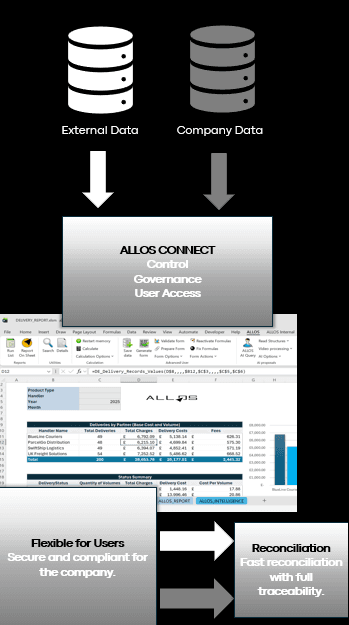
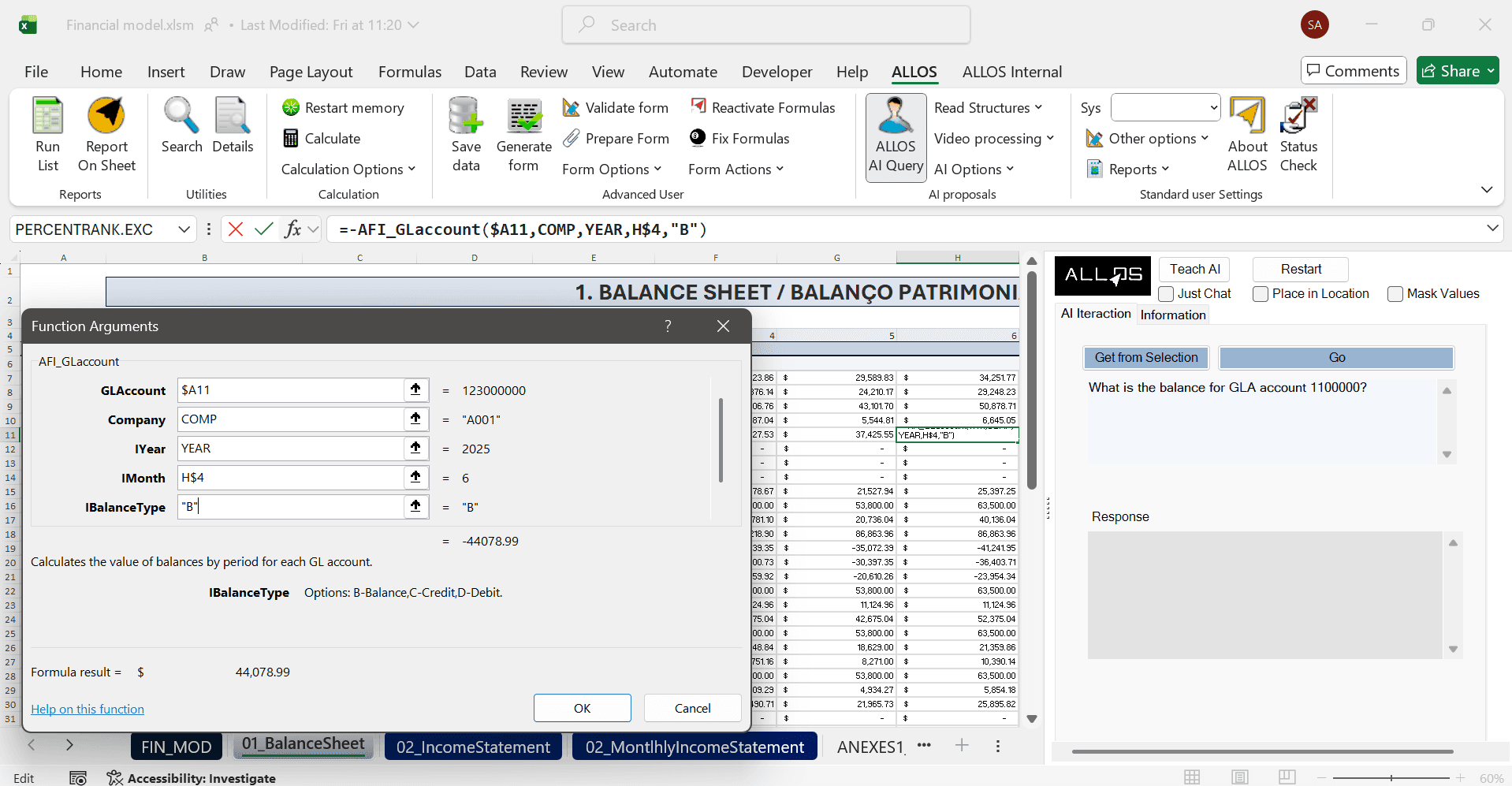
ALLOS is an enterprise data operations platform that governs how Excel and Word interact with live enterprise data.
It turns Office from an uncontrolled endpoint into a governed enterprise interface—providing centralized control for security, performance, and compliance while preserving business flexibility.
ALLOS is an enterprise data operations platform that governs how Excel and Word interact with live enterprise data.
It turns Office from an uncontrolled endpoint into a governed enterprise interface—providing centralized control for security, performance, and compliance while preserving business flexibility.

How Does allos work?


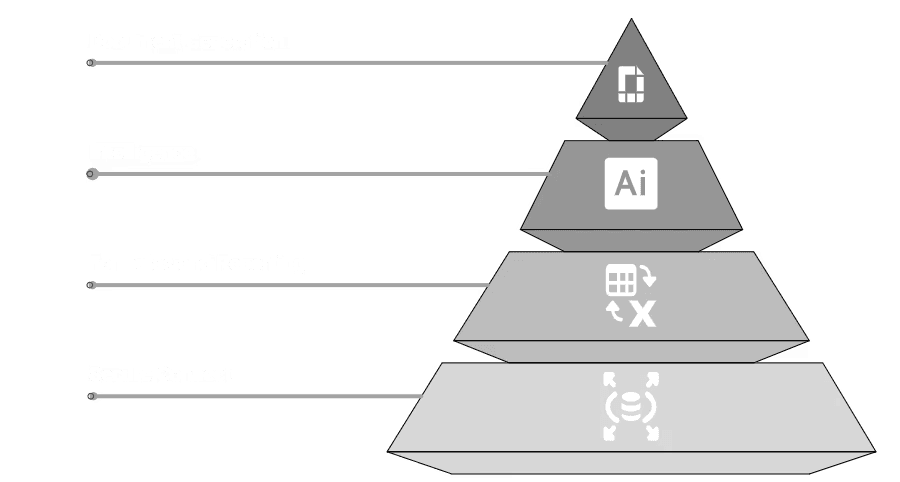
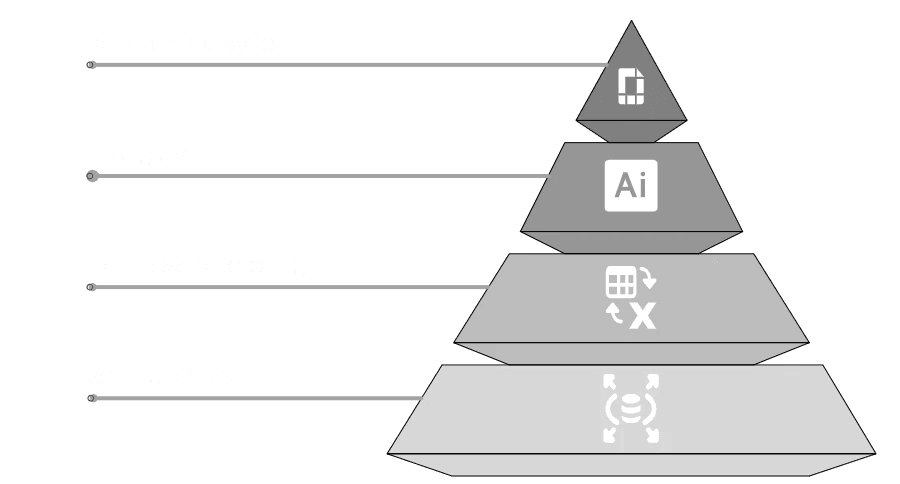
ALLOS sits between source systems and Office. Data access, business logic, and execution are defined once, managed centrally, and reused across reporting, document generation, and analysis—with full traceability to underlying transactions.
Four integrated layers:
. Secure Connect - Governed access to SAP, databases, and APIs to ensure controlled, auditable data movement.
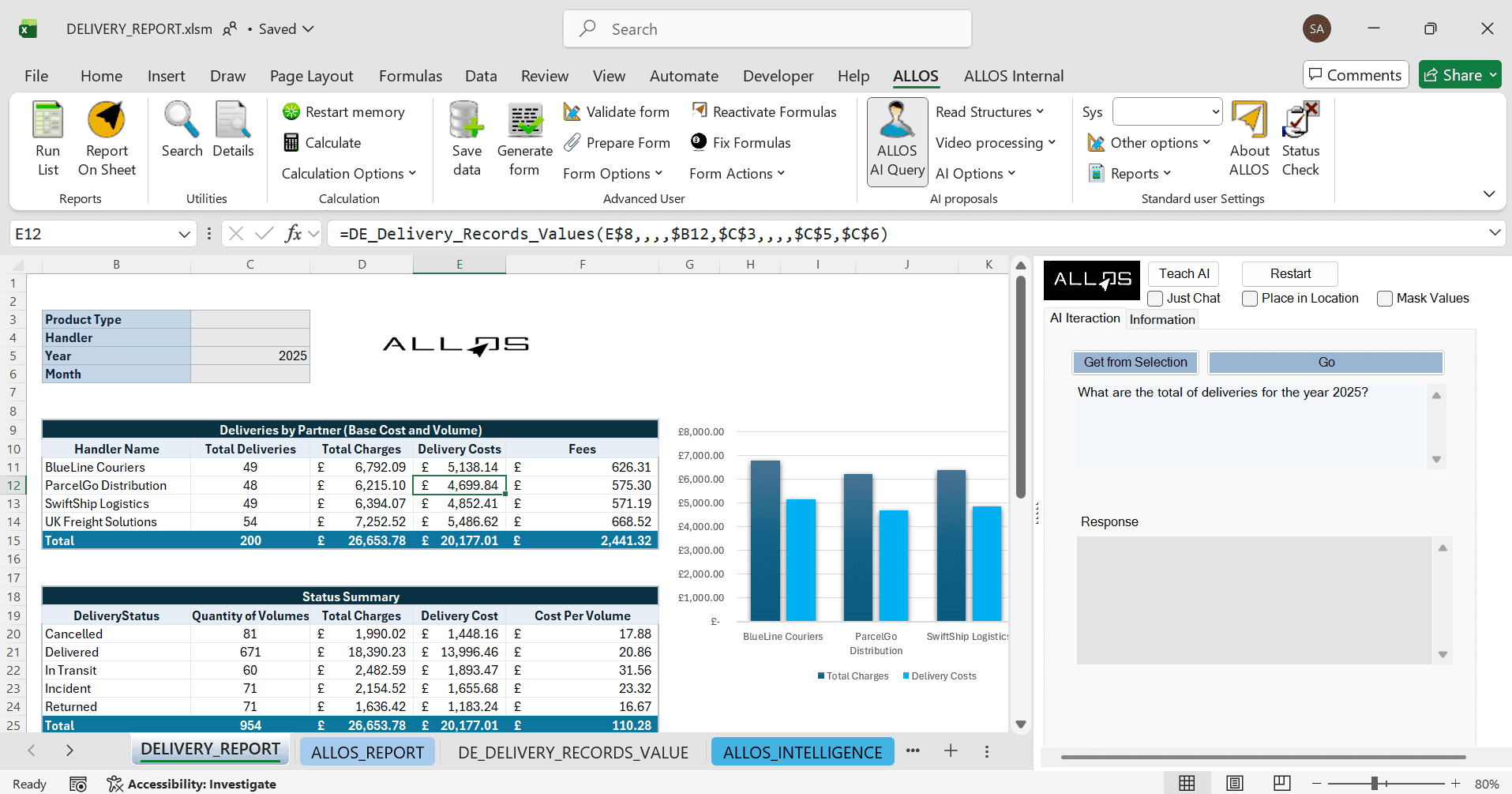
. Formulas & Reporting - Centrally executed calculations that deliver real-time, reliable results into Excel without exports.
. Document Generation - Automated Word, Excel, and PDF outputs using templates tied to governed data sources.
. Intelligence - AI that converts intent into approved queries while all data execution stays secure and governed.
Find More Details:
Security & Governance
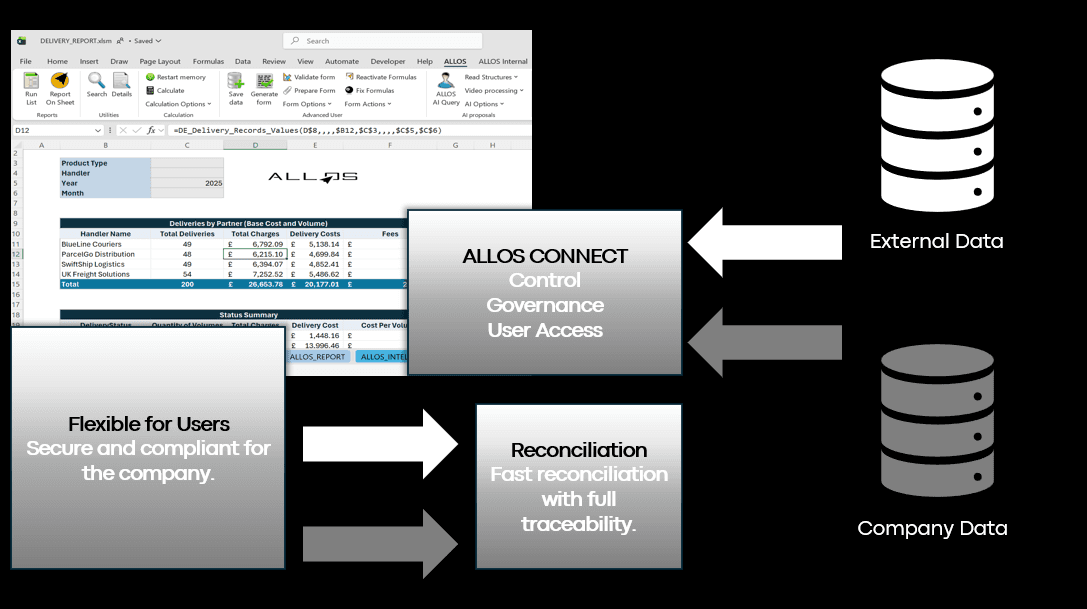
All processing runs inside company infrastructure with controlled access, auditability, and traceability. The platform supports human-in-the-loop workflows where results remain explainable and reconcilable—avoiding "AI said so" outputs.
Find More Details:
Auditability Model, Access Control, Lineage, and Compliance Certifications


Operational OUTCOMES
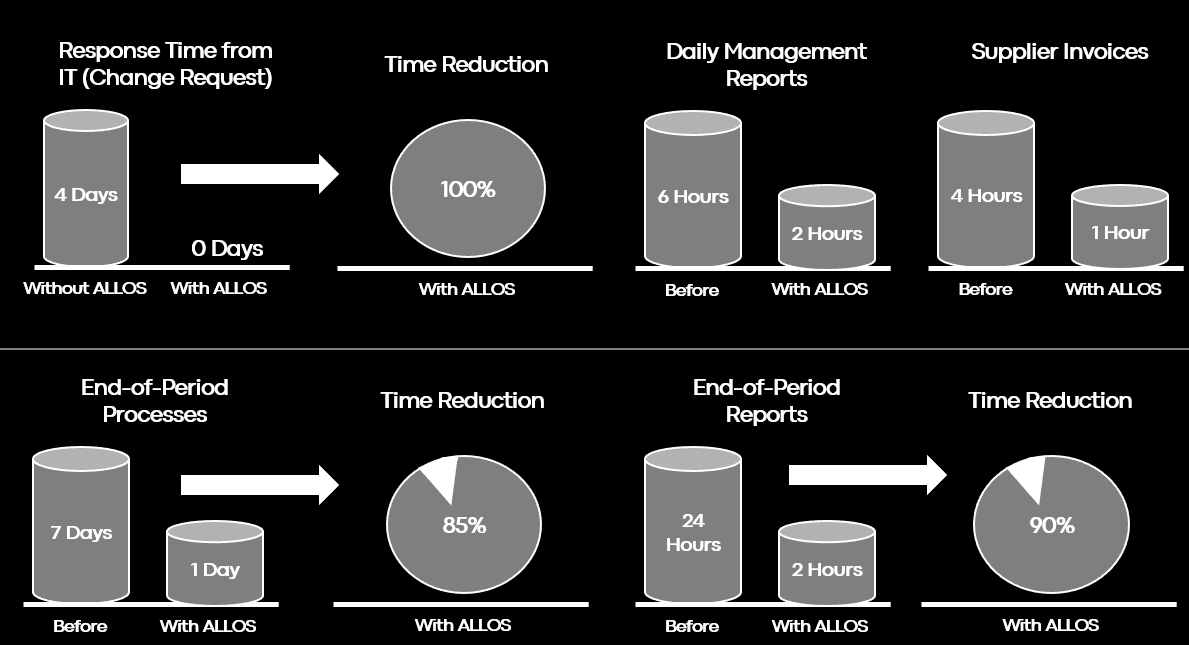
Flexible delivery without loss of control. Consistent metrics. Reduced reporting risk. Faster cycles.
Typical outcomes include improved month-end reporting, reconciled management reporting, and compliant documentation packages.
Proven Results:
. 400% faster bank reconciliation (Wayfield)
. 75% time saved on monthly reports (Aquapor)
. Total independence maintaining a centrally managed model (Navarra)
Flexible delivery without loss of control. Consistent metrics. Reduced reporting risk. Faster cycles. Typical outcomes include improved month-end reporting, reconciled management reporting, and compliant documentation packages.
Proven results:
. 400% faster bank reconciliation (Wayfield)
. 75% time saved on monthly reports (Aquapor)
. Total independence maintaining a centrally managed model (Navarra)


I already have BI, why do I need ALLOS?
BI tools are designed for dashboards and visualization, not for the day-to-day work that happens in Excel and Word. When users need flexibility—ad-hoc analysis, operational reporting, reconciliations, month-end files, project reports—they export data, rebuild logic, and maintain parallel versions outside BI. This creates inconsistent numbers, manual effort, and governance risk. ALLOS solves the part BI cannot: governed, real-time data and logic inside Excel and Word. Users keep the flexibility they rely on, while IT keeps control of permissions, formulas, definitions, and data access. ALLOS does not replace BI; it closes the gap between core systems and the spreadsheets where most operational and financial work actually happens.
Why should I use ALLOS, when I already have Excel?
Excel reports depend on exports, manual refreshes, and logic built into individual files. This creates inconsistent numbers, version drift, slow updates, and limited governance. ALLOS replaces exports and spreadsheet-level logic with a centrally executed layer that retrieves live data directly from systems like SAP and SQL. Calculations, filters, and definitions are defined once, executed on the platform, and reused across all reports. Teams keep working in Excel, but the data is real-time, traceable, and controlled. IT maintains permissions and governance, while users gain faster reporting, reconciliation takes minutes, and consistent results every time.
Is my Company Data safe with ALLOS?
Yes. Your data never leaves your infrastructure. You control what gets processed, where it's processed (including private Azure environments), and which models have access. Sensitive data can be masked automatically, and all credentials and actions are encrypted and logged.
Is ALLOS just an Excel add-in?
We understand why it might look that way—ALLOS runs inside Excel, because that's where your team already works. But ALLOS is much more than a plugin. Excel is the interface. ALLOS is the infrastructure. It's an Enterprise Data Operations Platform with: • Direct database connectivity (no dependence on Excel data) • A custom formula engine (not regular Excel formulas) • Full security, compliance, and audit layers • AI orchestration with model switching and governance • Integration with both Excel and Word as front-end interfaces • Document automation, reporting, and user-specific access controls
How does ALLOS differ from other Excel-to-data platforms?
Most platforms expose enterprise data in Excel through connectors or models. They make data available, but logic execution is often slow or fragmented. ALLOS takes a different approach by exposing enterprise logic as ultra-fast, governed Excel formulas. Users work with functions such as A_SALES(...) that feel native and flexible, while permissions, business rules, and data consistency are enforced automatically in the background. This allows Excel to remain fast and usable at enterprise scale—without sacrificing control, security, or trust.
I already have BI, why do I need ALLOS?
BI tools are designed for dashboards and visualization, not for the day-to-day work that happens in Excel and Word. When users need flexibility—ad-hoc analysis, operational reporting, reconciliations, month-end files, project reports—they export data, rebuild logic, and maintain parallel versions outside BI. This creates inconsistent numbers, manual effort, and governance risk. ALLOS solves the part BI cannot: governed, real-time data and logic inside Excel and Word. Users keep the flexibility they rely on, while IT keeps control of permissions, formulas, definitions, and data access. ALLOS does not replace BI; it closes the gap between core systems and the spreadsheets where most operational and financial work actually happens.
Why should I use ALLOS, when I already have Excel?
Excel reports depend on exports, manual refreshes, and logic built into individual files. This creates inconsistent numbers, version drift, slow updates, and limited governance. ALLOS replaces exports and spreadsheet-level logic with a centrally executed layer that retrieves live data directly from systems like SAP and SQL. Calculations, filters, and definitions are defined once, executed on the platform, and reused across all reports. Teams keep working in Excel, but the data is real-time, traceable, and controlled. IT maintains permissions and governance, while users gain faster reporting, reconciliation takes minutes, and consistent results every time.
Is my Company Data safe with ALLOS?
Yes. Your data never leaves your infrastructure. You control what gets processed, where it's processed (including private Azure environments), and which models have access. Sensitive data can be masked automatically, and all credentials and actions are encrypted and logged.
Is ALLOS just an add-in?
We understand why it might look that way—ALLOS runs inside Excel, because that's where your team already works. But ALLOS is much more than a plugin. Excel is the interface. ALLOS is the infrastructure. It's an Enterprise Data Operations Platform with: • Direct database connectivity (no dependence on Excel data) • A custom formula engine (not regular Excel formulas) • Full security, compliance, and audit layers • AI orchestration with model switching and governance • Integration with both Excel and Word as front-end interfaces • Document automation, reporting, and user-specific access controls
How does ALLOS differ from other Excel-to-data platforms?
Most platforms expose enterprise data in Excel through connectors or models. They make data available, but logic execution is often slow or fragmented. ALLOS takes a different approach by exposing enterprise logic as ultra-fast, governed Excel formulas. Users work with functions such as A_SALES(...) that feel native and flexible, while permissions, business rules, and data consistency are enforced automatically in the background. This allows Excel to remain fast and usable at enterprise scale—without sacrificing control, security, or trust.
I already have BI, why do I need ALLOS?
BI tools are designed for dashboards and visualization, not for the day-to-day work that happens in Excel and Word. When users need flexibility—ad-hoc analysis, operational reporting, reconciliations, month-end files, project reports—they export data, rebuild logic, and maintain parallel versions outside BI. This creates inconsistent numbers, manual effort, and governance risk. ALLOS solves the part BI cannot: governed, real-time data and logic inside Excel and Word. Users keep the flexibility they rely on, while IT keeps control of permissions, formulas, definitions, and data access. ALLOS does not replace BI; it closes the gap between core systems and the spreadsheets where most operational and financial work actually happens.
Why should I use ALLOS, when I already have Excel?
Excel reports depend on exports, manual refreshes, and logic built into individual files. This creates inconsistent numbers, version drift, slow updates, and limited governance. ALLOS replaces exports and spreadsheet-level logic with a centrally executed layer that retrieves live data directly from systems like SAP and SQL. Calculations, filters, and definitions are defined once, executed on the platform, and reused across all reports. Teams keep working in Excel, but the data is real-time, traceable, and controlled. IT maintains permissions and governance, while users gain faster reporting, reconciliation takes minutes, and consistent results every time.
Is my Company Data safe with ALLOS?
Yes. Your data never leaves your infrastructure. You control what gets processed, where it's processed (including private Azure environments), and which models have access. Sensitive data can be masked automatically, and all credentials and actions are encrypted and logged.
Is ALLOS just an add-in?
We understand why it might look that way—ALLOS runs inside Excel, because that's where your team already works. But ALLOS is much more than a plugin. Excel is the interface. ALLOS is the infrastructure. It's an Enterprise Data Operations Platform with: • Direct database connectivity (no dependence on Excel data) • A custom formula engine (not regular Excel formulas) • Full security, compliance, and audit layers • AI orchestration with model switching and governance • Integration with both Excel and Word as front-end interfaces • Document automation, reporting, and user-specific access controls
How does ALLOS differ from other Excel-to-data platforms?
Most platforms expose enterprise data in Excel through connectors or models. They make data available, but logic execution is often slow or fragmented. ALLOS takes a different approach by exposing enterprise logic as ultra-fast, governed Excel formulas. Users work with functions such as A_SALES(...) that feel native and flexible, while permissions, business rules, and data consistency are enforced automatically in the background. This allows Excel to remain fast and usable at enterprise scale—without sacrificing control, security, or trust.